Motorcycle Accident Lawyer Denver: After a Crash, Colorado Riding Laws and Choosing One
Last updated
This guide is for motorcyclists hurt in Denver, Colorado. It covers the steps after a crash, how to get the report, the Colorado riding rules that often come up in a claim, where a local case is filed, and how to compare motorcycle accident lawyers. Denver has about 740,613 residents, according to the U.S. Census Bureau (2025).
Everything here is general information from Colorado statutes and official agency pages, checked November 2026. Major roads through Denver include I-25, I-70, Colfax Avenue and Colorado Boulevard.
After a Motorcycle Crash in Denver
- Stay at the scene if you safely can. Every driver in a crash with injuries must stop, help the injured and report it, under C.R.S. 42-4-1601, 42-4-1603 and 42-4-1606.
- Get checked by a doctor even if you rode away. Road rash, wrist and head injuries are easy to underestimate.
- Keep the helmet and riding gear as they are. Damage to them can show how the crash happened.
- Photograph the bike, the other vehicle, the road surface and any debris or potholes.
- Write down witness names and keep repair estimates and medical bills together.
Getting the Crash Report in Denver
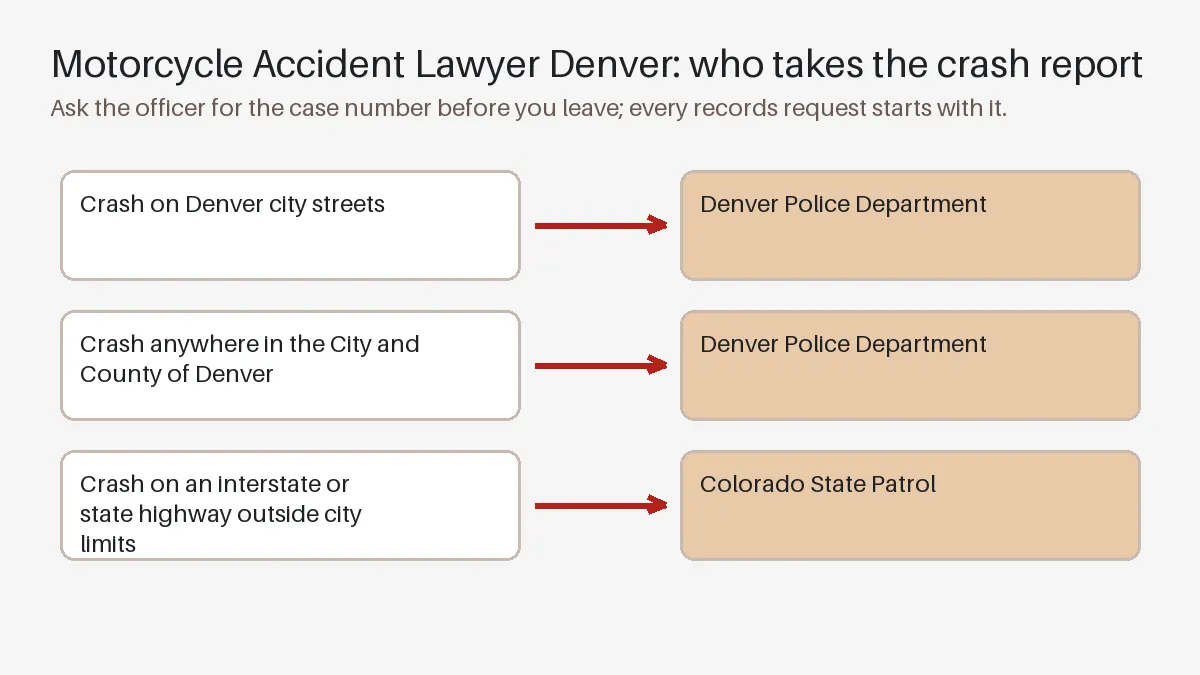
- City streets: the Denver Police Department usually takes the report; copies are requested through its records page.
- Unincorporated Denver: there are none. Denver is a consolidated city and county, so the Denver Police Department covers the whole county.
- Interstates and state highways in unincorporated areas are usually worked by the Colorado State Patrol; its crash information page explains how to request a copy.
Colorado Rules for Riders and Claims
- Helmets: Colorado requires a helmet only for motorcycle operators and passengers under 18, under C.R.S. 42-4-1502(4.5). The Colorado State Patrol also advises that every rider must use some form of eye protection, such as a visor, goggles or glasses.
- Lane filtering: Since August 7, 2024, C.R.S. 42-4-1503 lets a two-wheeled motorcycle filter past vehicles only when traffic in its lane and the next lane is fully stopped, at 15 miles per hour or less, passing on the left. Riding between moving vehicles and passing on the shoulder are still not allowed, and the filtering rule is set to expire on September 1, 2027.
- Deadline: three years for most injury lawsuits arising from a motor vehicle crash, under C.R.S. 13-80-101(1)(n), and 182 days for written notice of a claim against a public entity, under C.R.S. 24-10-109.
- Shared fault: under C.R.S. 13-21-111 damages are reduced by the rider's share of fault, with no recovery at 50 percent or more.
Where Denver Motorcycle Cases Are Filed
Injury lawsuits from Denver are generally filed in the Denver District Court, part of Colorado's 2nd Judicial District, at 1437 Bannock Street, Denver, CO 80202 (Denver City & County Building, civil matters). Smaller claims may go to county court, and most claims settle.
Local Crash Data
63 people died in motor vehicle traffic crashes in Denver County in 2024, according to the federal Fatality Analysis Reporting System. The figure covers the whole county and every type of road.
How to Choose a Motorcycle Accident Lawyer in Denver
- Check the license in the Colorado attorney search run by the Office of Attorney Regulation Counsel.
- Ask how many motorcycle cases the lawyer has handled, since insurers often argue that a rider was speeding or hard to see.
- Get any contingency fee in writing, as Rule 1.5(c) of the Colorado Rules of Professional Conduct requires.
- Be wary of uninvited contact soon after a crash. C.R.S. 13-93-111 bars soliciting an injured person within 30 days.